
Bridging C4 Software Architecture Modeling with AWS Cloud Infrastructure Diagrams
In my experience, applying the C4 model to cloud infrastructure design—particularly within AWS—can be remarkably effective. The C4 model, with its hierarchical approach to visualizing software architecture, provides clarity at multiple levels: Context (C1), Container (C2), Component (C3), and Code (C4). When planning cloud architectures, I’ve found that the first three levels (C1–C3) map especially well to AWS concepts.
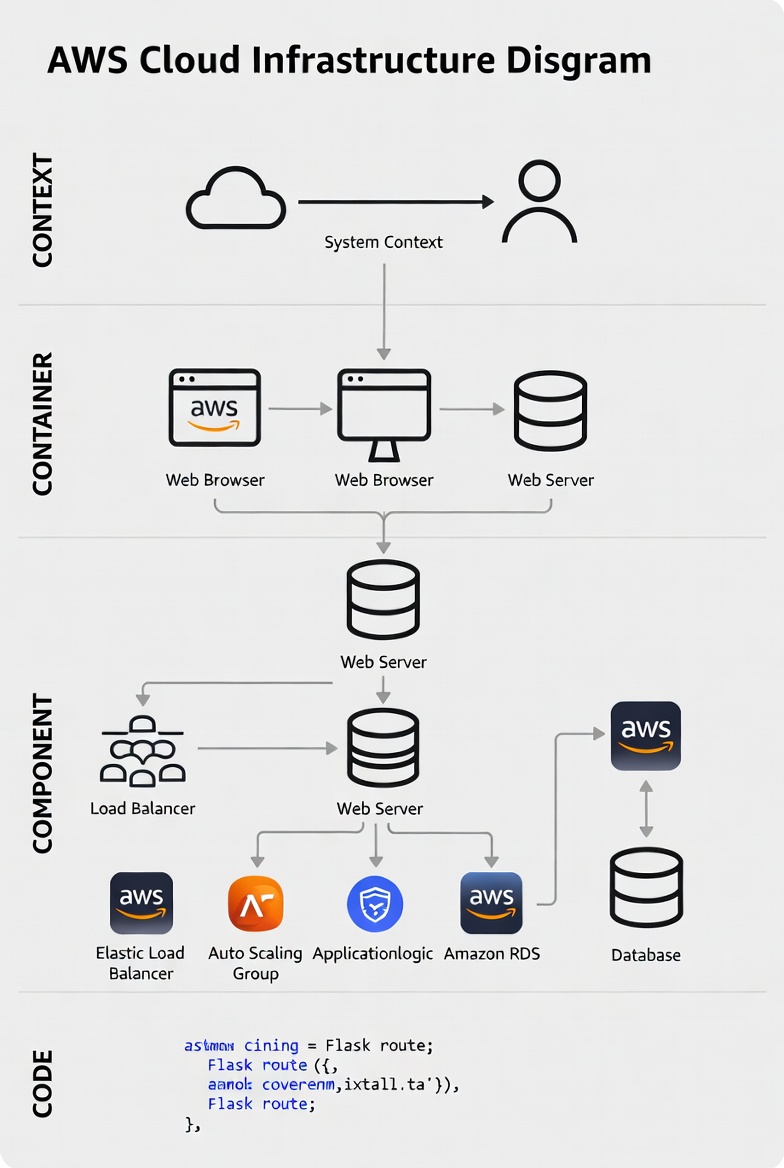
At the C1 (Context) level, we define the system’s scope and its interactions with users, external systems, and other applications. In an AWS environment, this can translate to identifying key services and external integrations, such as API Gateway endpoints, third-party services, or user-facing applications. This level helps stakeholders understand the “big picture” before diving into technical details.
The C2 (Container) level dives into the main building blocks of the system, which, in cloud terms, can be represented as AWS services or groups of services. For example, a container could correspond to an EC2-backed application, a Lambda function, or an ECS cluster. Mapping containers to AWS services provides a clear understanding of how the system is deployed and how different parts communicate over the cloud infrastructure.
The C3 (Component) level often aligns directly with AWS component diagrams. At this level, we focus on individual components within a container—like a specific microservice, a database module, or a message queue—and show their interactions. AWS diagrams can visually represent these components using icons for RDS, S3, SQS, or Lambda, allowing technical teams to bridge the gap between abstract architecture and concrete cloud resources.
By leveraging the C4 model for cloud infrastructure, teams gain a structured approach to design that scales from conceptual understanding to detailed implementation. It also ensures alignment between software architecture and cloud infrastructure, reducing ambiguity and improving communication across development, operations, and business stakeholders.